
Adorn Yourself Accordingly
“First, know who you are, then adorn yourself accordingly.”— Epictetus

I’ve never cared much for the new. I like things with a past: the more worn, the better. A visit to an old church, an antique desk in a local store, a caring relative writing a now barely legible letter—those always captured my attention. I’d have to check with my parents, but I believe my obsession started with collecting rocks and minerals, then fossils. Somehow, my dad convinced me to collect stamps. Then came the coins.
Growing up in the Netherlands, I collected old Dutch coins—especially those from the VOC and the Dutch East Indies, since they were affordable. As a kid, I wasn’t interested in shiny commemoratives or modern coinage. I had, and still have, no interest in coins that are ‘rare’ because of an obscure minting error. I want coins to feel heavy with history. I wonder who touched them, what ships they’d sailed, what markets they passed through. When I was young, I read about coins found preserved in clay pots near the river Rhine, close to where I grew up. I think—though who can be sure—that’s when my daydreams about ancient coins began. Yet nothing ever came of that interest because I thought ancient coins were out of reach: fragile and rare artifacts reserved for museums or the ultra-rich.
My childhood passion for coins is inversely proportional to the advent of my teenage years. I moved to the United States in 2016, and for a long time, I assumed my belief that ancient coins were unattainable was well-founded. When I discovered that I was wrong—and that many ancient coins were not only accessible but astonishingly well-preserved—it changed everything. I began with affordable late Roman bronze coins. I researched the emperors on the front (the obverse) and the reverse sides. What I found was an endless source of information and wonderment: an emperor in office for 88 days before being assassinated (Florian), Zeus’ sprawling beard on coins from Egypt (Ptolemaic), a mysterious miracle plant now extinct (Silphium). Such a coin isn’t just a relic—it is enduring evidence of the past.
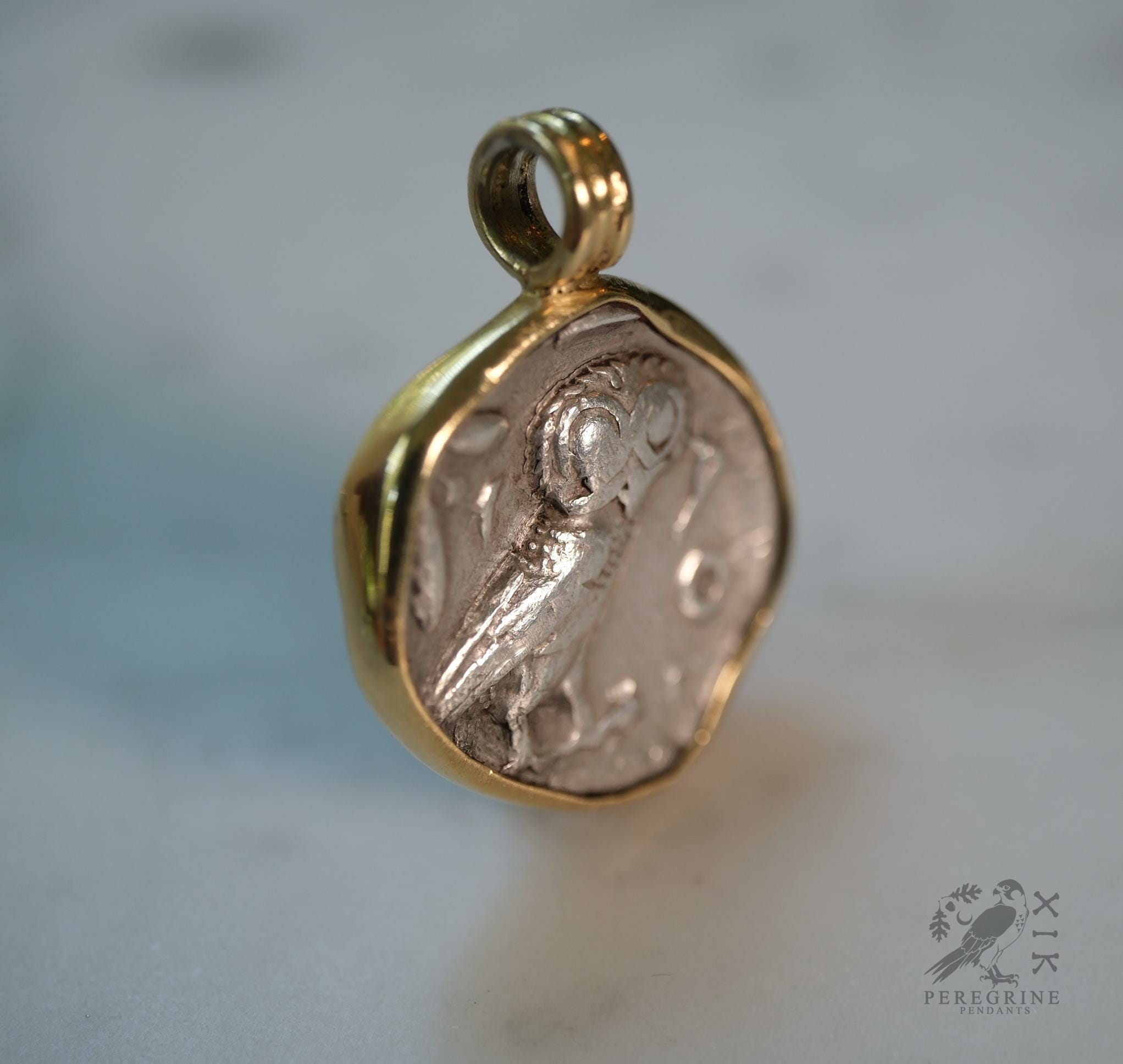
After a period of buying and selling (the breadth of ancient coinage is, in my view, unparalleled), I finally saved enough to buy the coin I had always admired: a silver Athenian owl tetradrachm. Struck over two millennia ago, it carried the image of Athena on one side and her owl—sharp-eyed, defiant—on the other. It was beautiful, weighty, and alive with meaning. I wanted to carry it with me (apparently Theodore Roosevelt felt the same way).
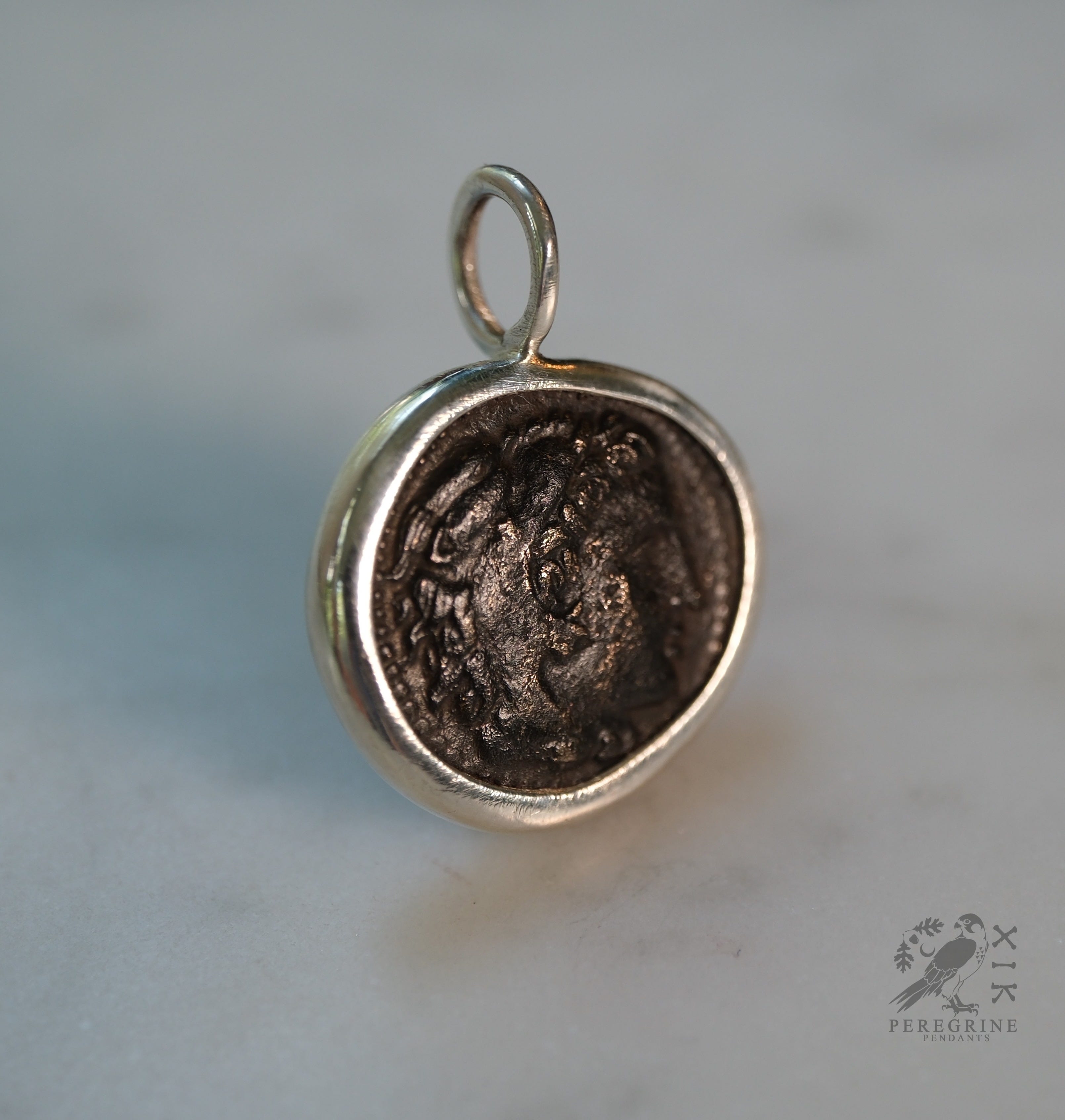
To satisfy my desire to carry it, I purchased a vintage sterling silver pill box, which had a small loop (bail) at the top that worked with a chain I had. I brought that owl with me, sometimes showing it to a friend or family member—but that wasn't the point. The point was to have it close. Though the box had its utility, I found myself wanting to be able to see the coin, not just have it. So I began searching for a durable way to wear it as a pendant.
I was disappointed by what I found: a plethora of replicas, authentic but extremely overpriced pieces, or (worse) pendants with mass-produced bezels intended for perfectly round coins. These coins are anything but perfect or round. So I decided to make my own. Not with the Athenian owl—that was too precious to experiment with—but with a simple late Roman bronze coin (the inexpensive kind). After much trial and error, I learned how to assess a coin’s shape and features and determine an appropriate setting.
Coincidentally, I discovered that my other passion—law—shared a bond with this one. Their commonality is captured in Aristotle’s writing:
“Money has become by convention a sort of representative of demand; and this is why it has the name ‘money’ (nomisma), because it exists not by nature but by law (nomos), and it is in our power to change it and make it useless.”
The idea that value is assigned—not inherent—echoes across law, history, and art. It’s at the core of what I try to honor. These coins were once exchanged for goods and favors. Now, they’re exchanged for their meaning (and their visual appeal doesn’t contradict that). That’s how Peregrine Pendants began: a way to unite my passion for the old and worn with my respect for meaningful craftsmanship.
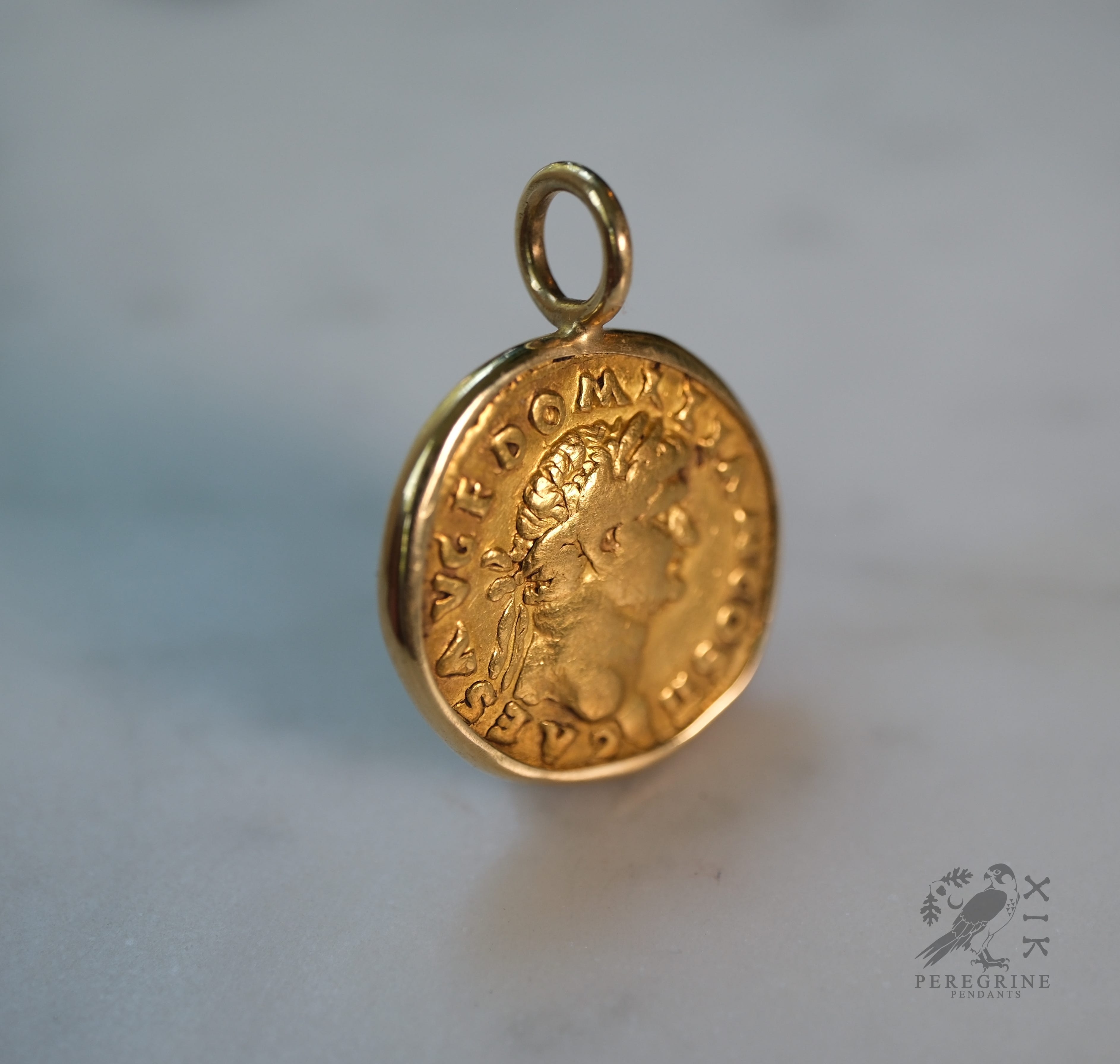
I create custom settings—by hand, in 18k gold or sterling silver—for each coin. Each one is designed to highlight the coin’s character, not overshadow it with unnecessary bells and whistles. If a coin has a legible inscription, I aim to keep it visible while ensuring the coin is secure. If a coin has a peculiar shape, I’d rather highlight it than obscure it.
There’s a paradox within ancient coins. While coins are, by definition, mass-produced, each pendant I make is one of a kind. Not just because the setting is unique (it is), but because each coin is unique. Every coin is real and accompanied by a certificate providing, at minimum, guideposts to its past. If I could, I’d write a book about the obverse, reverse, and region where each coin was struck.
As I’ve said, I prefer a worn coin—one roughed up by the elements, shaped by whatever life had in store for it. It brings to mind a quote by Hunter S. Thompson:
“Life should not be a journey to the grave with the intention of arriving safely in a pretty and well-preserved body, but rather to skid in broadside in a cloud of smoke, thoroughly used up, totally worn out, and loudly proclaiming ‘Wow! What a ride!’”
He was talking about life, not coins—but I like to imagine he was referring to ancient coins. Whether worn daily or passed down, these pieces carry millennia of weight, crafted to last centuries more.
I too love coins. They carry past energy. The history follows it.
This was a beautiful tribute to your passion.
Thank you for sharing.
Lina.